Classroom notes
Teaching trading in a university classroom, without risking a cent
October 9, 2026 · By SukiBlog
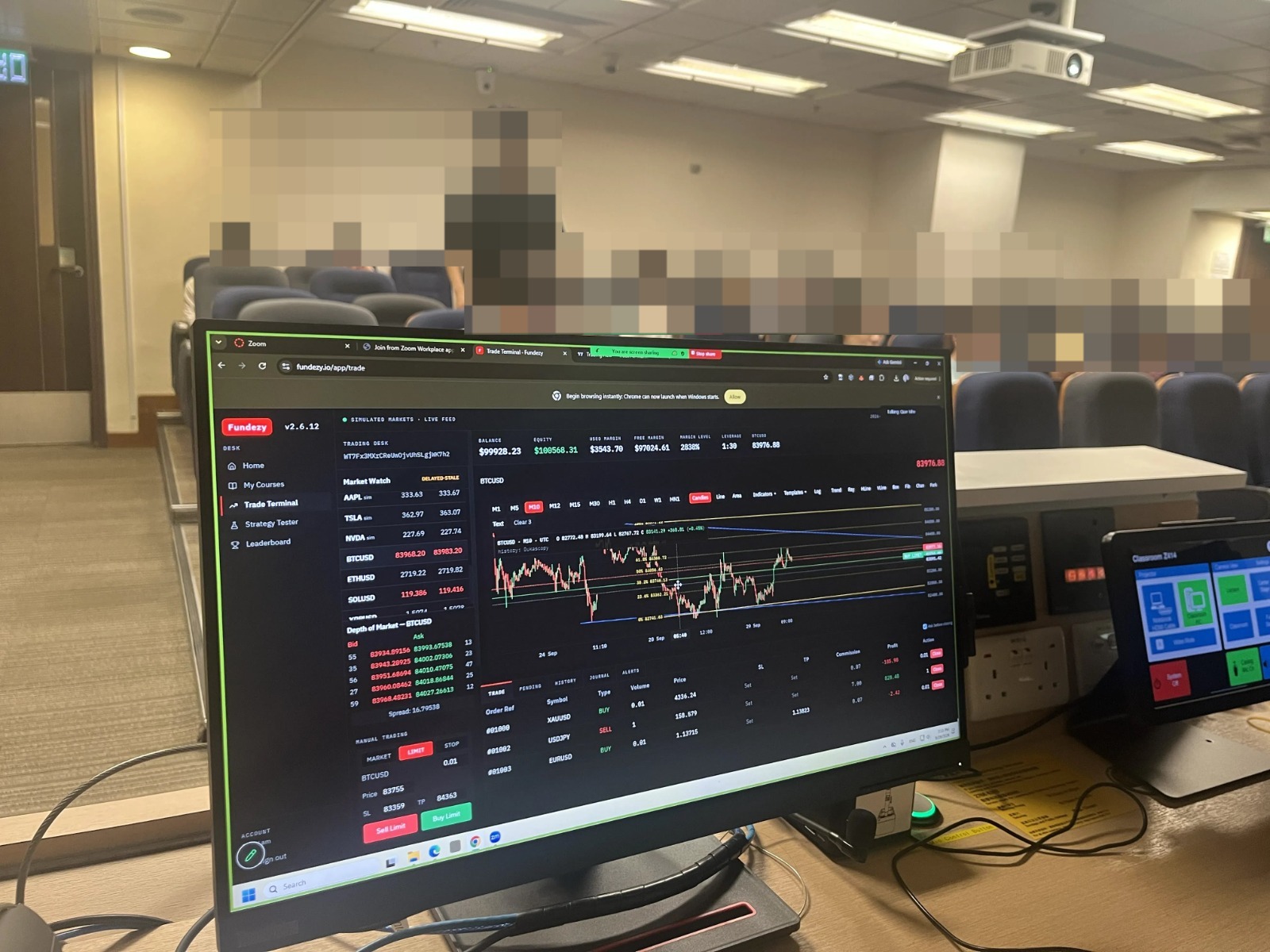
Fundezy, a free simulated-trading platform, has been used in university classes in Hong Kong since the end of September 2026. Instructors use it to illustrate trading ideas with real market prices, and students practise what they learn on a simulated $100,000 account, then compete in weekly simulated trading competitions. No real money is involved at any point.
That is Fundezy in its natural habitat. Not a demo day. Not a hackathon. A regular class, in a regular semester: a podium computer signed into a trading desk, watchlist on the left, an EUR/USD chart in the middle, an order ticket on the right, and a lecture starting in twenty minutes.
What is simulated trading?
Simulated trading (sometimes called paper trading) is practice with real market prices and pretend money. On Fundezy the prices are real, delayed just enough for classroom use. The $100,000 account is not. Students sign up with an email address — no credit card, no deposit — and trade the same instruments you would see on a professional desk: forex majors and crosses, gold, oil, indices, US stocks.
The fills, spreads, commissions, margin calls and stop-outs are real mechanics, not decorations. A lesson on costs is also a lesson the platform itself teaches: every fill crosses the bid/ask spread, every closed position pays a $7-per-lot round-turn commission, and every account that lets its margin run thin sees a margin call in its journal below 100% margin level — and stop-outs below 50%, when the engine starts closing positions for you.
Why simulate?
Because the fastest way to learn trading mechanics is to place real orders and watch what happens to them. Reading about stop-loss orders is one thing; watching your stop get slipped in a fast market is another. The only safe place to have that experience is a simulator, and the only honest simulator is one that charges you commission and issues margin calls and stop-outs exactly as the lessons describe.
Simulated money removes the one thing that makes trading education hard to teach at scale: fear. Nobody's tuition money is on the line, so students will actually place the trade, watch it go wrong, read their journal, and try again. That loop, place, observe, adjust, repeat, is the entire method. The exam is your own track record.
What do the students actually do?
The classroom version runs on a simple loop: learn, practise, compete.
- Learn. Six structured courses, 30 lessons, about three hours of reading in total, from "what is a pip" to writing your first Expert Advisor. The courses are assigned reading; the platform shows each student's completion state, so homework checks itself.
- Practise. Every concept lands on the order ticket the same week it is taught. A lesson on position sizing ends at the lot-size field. A lesson on stops ends at the SL/TP fields. Nothing stays theoretical for long.
- Compete. This is the part students ask about by name: the simulated trading competition. Classes run weekly rounds. Students join teams, and a live leaderboard ranks desks while the round is open. Rounds rank on more than raw return, so a single lucky lottery-ticket trade does not win the week.
In these first weeks of classroom use, learners on the platform have placed more than 1,900 simulated trades. Some of them are beginners discovering what a spread is. A minority go further and write Expert Advisors: small programs that trade by rules, backtested over years of real historical tick data before they are allowed anywhere near the live round. For those students the spreadsheet becomes a program; the program becomes a strategy; the strategy becomes a ranking on the leaderboard.
Three things we learned in the first weeks
1. The leaderboard is the syllabus's best friend. Assigned reading gets read when a round starts Monday and the leaderboard updates while you watch. Engagement follows the competition, not the other way round.
2. Risk management is discovered, not announced. You can say "use stops" until you are hoarse. It sinks in the first time a position blows through a round without one. Simulated losses teach the lesson; a leaderboard that ranks on more than raw return quietly rewards the students who took it seriously.
3. Pretend money makes some students reckless, and that is the point. Give any class $100,000 of play money and a percentage of it will find the most exciting instrument and size up. Better they learn that about themselves in a simulator at 9:40am on a Thursday than with a real brokerage account at 2am.
What does the educator get?
- No infrastructure. No brokerage partnership, no bank sandbox, no IT project. Sign-in is an email address.
- Cohort control. Groups can be locked to your students' email domain, so the leaderboard contains your class and nobody else's.
- A running semester, not a one-off demo. Weekly competition rounds, team standings, and completion certificates for the course work.
- It costs nothing. The courses, the simulator, the competitions: free, no credit card, no premium tier.
How can educators start?
- Create a free account at fundezy.io with an email address and take Course 01 yourself. Five lessons in, you will read a quote like a trader.
- Write to info@fundezy.io and ask for a group for your cohort, locked to your students' email domain.
- Open your first round in week one. Watch the reading get done.
We built Fundezy because trading education is dominated by hype and upsells. The counter-offer is a computer lab, real prices, pretend money, and a leaderboard that tells the truth. It fits in a semester, and it fits in a Thursday morning.
Frequently asked questions
- Is the trading real?
- No. Prices are real market prices, slightly delayed. Accounts, money, fills and positions are simulated. Fundezy is not a broker, takes no deposits, and gives no investment advice.
- What do students need to sign up?
- An email address. Accounts are free, there is no premium tier, and nothing to install: the courses, the simulator, and the Strategy Tester all run in the browser.
- How much does it cost for a class?
- Nothing. Fundezy is free: no credit card, no premium tier. Educators can request a group for their cohort by emailing info@fundezy.io.
- Can I use Fundezy with my own students?
- Yes. Groups can be locked to your students' email domain, weekly trading competitions and team leaderboards are built in, and the six-course curriculum works as assigned reading. Email info@fundezy.io to set one up.

Author
Suki — Suki builds course material and runs the Fundezy classroom programme.
Try it as a student would
Free account, simulated $100,000, six courses. Five lessons in, you'll read a quote like a trader.